Choosing a humidifier for a Canadian winter
Ultrasonic, evaporative or steam? How to size a humidifier, what indoor humidity to aim for when it's −20 °C outside, and how to keep it clean.
Choosing a humidifier for a Canadian winter
For homes from Vancouver to Halifax where the furnace runs for months and the air gets dry enough to crack lips, shock you at every doorknob and shrink hardwood floors.
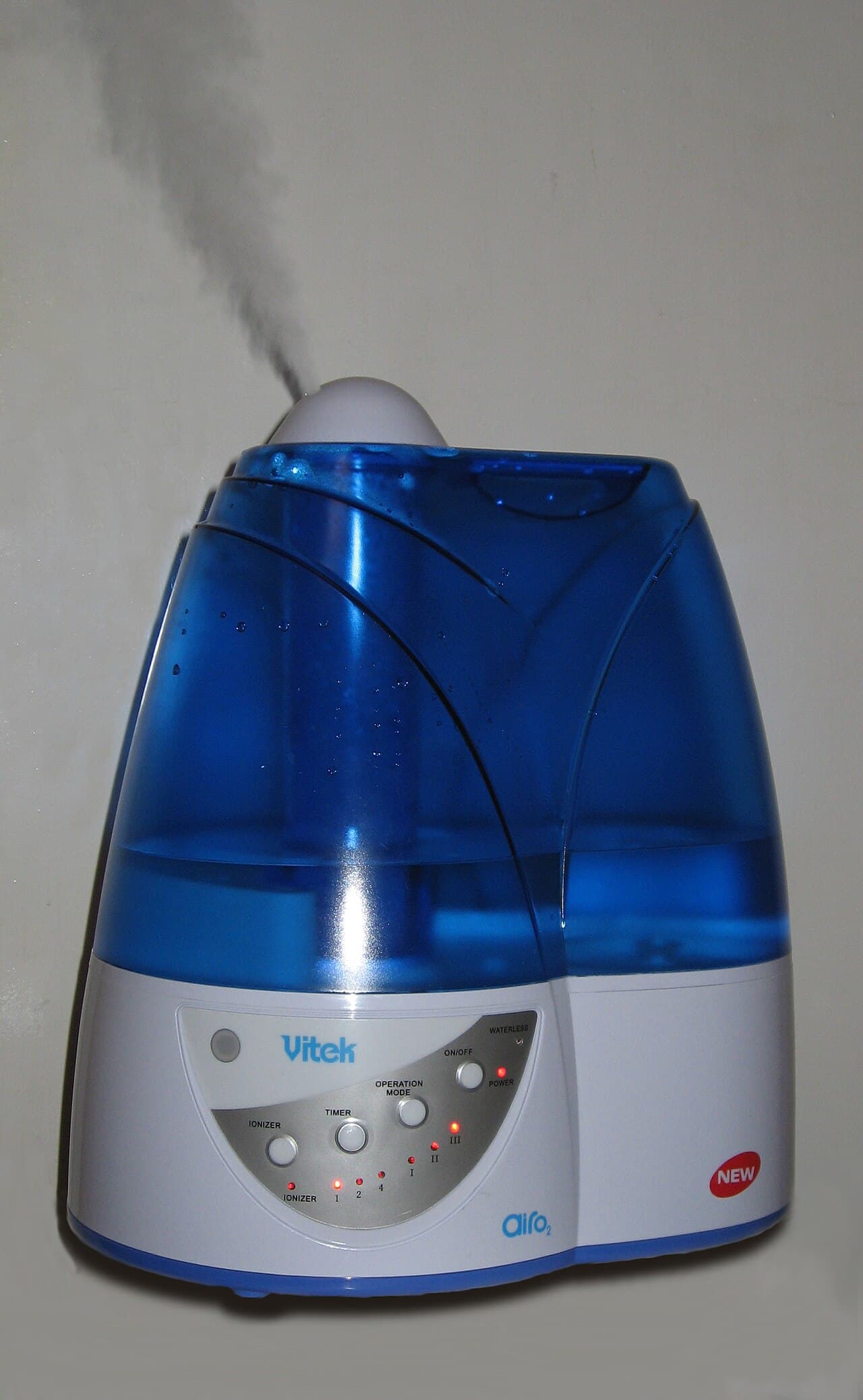 A small room humidifier. Photo: Wikimedia Commons (see credit at the end).
The short version
- Aim for 30–45 % relative humidity indoors in winter, and go lower when it's very cold outside to avoid condensation on windows.
- Evaporative humidifiers self-regulate and don't produce white dust; ultrasonic are quiet but need distilled or demineralized water; steam models are the most hygienic but use the most electricity.
- Size it to the space: a bedroom needs a small unit, an open-plan main floor needs a large console or a whole-house humidifier on the furnace.
- Clean it weekly. A dirty humidifier spreads microbes into the air.
- Buy a hygrometer (about $10–20) before you buy anything else.
Why Canadian homes get so dry
Relative humidity depends on temperature. Air at −15 °C holds very little water vapour; when your furnace warms it to 21 °C, its relative humidity can fall to 10–20 %. Symptoms are familiar: static shocks, dry eyes and skin, scratchy throats in the morning, gaps opening between hardwood boards and guitars going out of tune. Newer, airtight homes with an HRV or ERV usually stay a bit more humid than older, drafty ones.
How much humidity is right?
Too little is uncomfortable; too much causes condensation on windows and, over time, mould in window frames and exterior walls. Natural Resources Canada and CMHC advise lowering indoor humidity as outdoor temperatures fall. A commonly used guide:
| Outdoor temperature | Maximum indoor RH (approx.) |
|---|---|
| Above 0 °C | 45–50 % |
| 0 to −10 °C | 40 % |
| −10 to −20 °C | 35 % |
| −20 to −30 °C | 30 % |
| Below −30 °C | 25 % |
If water beads on the inside of your windows, humidity is too high for the current outdoor temperature (or your windows are poorly insulated). Turn it down.
Types of humidifier
Evaporative (cool mist)
A fan blows air through a wet wick or filter. Air can only absorb as much water as it can hold, so these units are naturally self-limiting. No white dust. Wicks must be replaced every 1–3 months depending on water hardness. Some fan noise.
Ultrasonic (cool or warm mist)
A vibrating plate turns water into a fine mist. Very quiet — popular for bedrooms and nurseries. With hard tap water (common in much of Ontario and the Prairies) they spread minerals as white dust on furniture; use distilled water or a demineralization cartridge. Easy to over-humidify without a built-in humidistat.
Steam (warm mist)
Boils water. Kills most microbes and produces no mineral dust, but uses more electricity (often 200–400 W) and the hot water is a burn risk around young children and pets.
Whole-house (furnace-mounted)
Bypass, fan-powered or steam humidifiers mounted on the ductwork of a forced-air system. They humidify the entire home automatically with a humidistat, some with an outdoor sensor that adjusts the target as it gets colder. Installation by an HVAC technician; annual pad change.
Comparison
| Type | Noise | White dust | Electricity | Maintenance | Best for |
|---|---|---|---|---|---|
| Evaporative | Medium | No | Low | Wick changes | Living areas, hard water |
| Ultrasonic | Very low | Yes, with hard water | Very low | Distilled water, cleaning | Bedrooms |
| Steam | Low (bubbling) | No | High | Descaling | Hygiene-conscious, no small kids |
| Whole-house | None in room | No | Low–medium | Annual pad | Forced-air homes |
Sizing
Manufacturers rate output in litres (or US gallons) per day and suggest a room size. As a rough guide: 2–4 L/day for a bedroom, 6–10 L/day for a large living room, and consoles of 12 L/day or more for an open main floor. Older, leaky houses need more output than new airtight ones. Look at tank size too: a 4 L tank on a 6 L/day machine means refilling twice a day.
Features worth paying for
- Built-in humidistat that holds a set RH (check it with a separate hygrometer — built-in sensors are often off by 5 % or more).
- Wide tank opening you can reach into to scrub.
- Auto shut-off when empty.
- Quiet / sleep mode for bedrooms.
- Dishwasher-safe parts on some models.
Features that matter less: aroma trays (essential oils can damage plastic and irritate airways), app control, and "antimicrobial" coatings that don't replace cleaning.
Cleaning and safety
Health Canada advises cleaning humidifiers regularly because stagnant water can grow bacteria and moulds that are then sprayed into the air:
- Empty the tank daily and refill with fresh water.
- Once a week, unplug, empty and scrub the tank and base; descale with white vinegar, rinse well.
- Disinfect as the manual says (some allow a dilute bleach or hydrogen peroxide solution), then rinse thoroughly.
- Replace wicks and filters on schedule.
- Dry the unit completely before storing it in spring.
Keep steam units out of reach of children, and don't place any humidifier where mist lands on walls, books or electronics.
Where to buy and compare
Humidifiers from brands such as Honeywell, Vicks, Levoit, Boneco, Crane, Pure Enrichment and Dyson are sold at Canadian Tire, Home Depot, Best Buy, Walmart, Costco, Lowe's/RONA and London Drugs. Prices vary a lot between seasons — they're cheapest in late spring. Before buying you can compare humidifier prices across Canadian shops and check the cost and availability of replacement wicks, which is the real long-term expense. For whole-house units, ask an HVAC contractor about rebates from your provincial utility.
Common mistakes
- Running it at 50 % when it's −25 °C outside — hello, wet windows.
- Using tap water in an ultrasonic unit in a hard-water area.
- Never cleaning the tank.
- Buying a tiny unit for an open-plan floor and running it flat-out.
- Ignoring the furnace humidifier you already have (check the pad!).
FAQ
Can a humidifier help with a cold or cough? Moist air can make a dry throat and nose more comfortable, but keep the unit clean and the humidity moderate. Ask a health professional about specific conditions.
Will a humidifier make the house feel warmer? Somewhat. Moist air feels warmer at the same temperature, so some people turn the thermostat down a degree.
What about plants and pets? Many houseplants love 40 % RH. Keep cords and hot units away from curious pets.
Sources: Health Canada (humidifier safety), Natural Resources Canada and CMHC (indoor humidity and condensation), manufacturer specifications. We have not personally tested the products named.
Photo credit: Ultrasonic humidifier, Wikimedia Commons, public domain.
